
Many dental practices look at buy up dental options to grow revenue, improve patient comfort, and offer treatment paths they couldn’t before. Buy up dental refers to elective, premium services patients choose or are offered—like higher sedation levels, in‑office general anesthesia, or advanced full‑mouth rehab. This article defines buy up dental, lays out the business case, covers clinical and operational needs, reviews risks and ROI, and explains how a turnkey anesthesia partner can help you pilot these services safely.
What “buy up dental” Means
Buy up dental describes higher‑tier services beyond routine dentistry that patients pay extra for. These services focus on comfort, efficiency, or enabling more complex care in the office. Examples include deeper levels of IV sedation, surgical‑grade anesthesia for full‑arch implant work, and same‑day surgical dentistry. Unlike routine care, buy up dental is elective and often marketed as an upgrade for anxious patients or complex cases.
Typical Buy-Up Dental Services Practices Offer
Common buy up dental services include: – IV moderate or deep sedation to keep patients comfortable for longer or more invasive procedures. – In‑office general anesthesia for complex full‑mouth rehab or multiple extractions. – Full‑arch implant surgery done under sedation to complete care in fewer visits. – Sedation protocols tailored for children, special‑needs, or medically complex patients. – Same‑day surgical dentistry that combines extractions, grafts, and implants under one anesthetic.
Why Practices Add Buy-Up Dental: The Financial Case
Adding buy up dental can raise the average ticket per patient and improve case acceptance. A single full‑arch case or multi‑tooth surgery under sedation can be several times more profitable than routine restorative work. Practices also get referrals from specialists and general dentists who lack in‑office anesthesia. Consider start‑up costs (equipment, training, permits) versus long‑term margins: once protocols and scheduling are efficient, net income per case typically improves.
Clinical & Operational Requirements For Buy-Up Dental
Equipment and facility needs
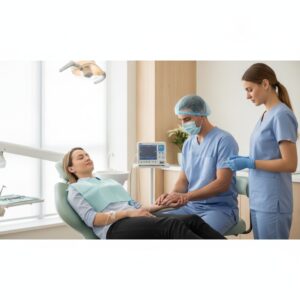
You need advanced monitoring systems, airway tools, and a recovery area. Practices can choose between fixed OR setups or hospital‑grade mobile anesthesia units that bring full surgical capability to the office without major construction.
Staffing, training, and credentialing
Staff must be trained in airway management and resuscitation (e.g., ACLS/PALS). Sedation permits and credentialing vary by state. For deep sedation or general anesthesia, a board‑certified anesthesiologist or equivalent credentialing is often advised to manage risk and regulatory expectations.
Protocols, documentation, and patient safety
Strong pre‑op assessment, written consent, medication protocols (including opioid‑free options), and recovery checklists are essential. Document vitals, sedation levels, and discharge criteria. Post‑op follow up reduces complications and builds patient trust.
Patient Selection, Consent, and Pricing Strategies
Ideal candidates for buy up dental are highly anxious patients, children, special‑needs individuals, and medically complex patients who need consolidated care. Present buy up dental as an option with clear benefits and risks. Use tiered pricing (basic sedation, deep sedation, general anesthesia) and transparent consent forms that list recovery time and out‑of‑pocket costs. Offer financing for higher‑ticket cases to improve acceptance.
Risks, Liability, and How To Mitigate Them
Medical risks include airway events, hemodynamic changes, and delayed recovery. Legally, inadequate documentation or staff training raises liability. Operational risks include longer scheduling blocks and recovery space needs. Mitigate by using standardized checklists, emergency drills, clearly defined roles, and working with clinicians who carry appropriate insurance and credentials. Maintain clear patient instructions and robust post‑op follow up.
How To Measure ROI On Buy-Up Dental
Track revenue per case, case acceptance rate, procedure mix, incremental profit, patient satisfaction scores, and referral volume. Monitor scheduling efficiency and average chair time. Run a 3–6 month pilot with set benchmarks (e.g., X number of cases, Y% acceptance uplift, Z% incremental margin) to validate demand and fine‑tune protocols before full rollout.
How America Anesthesia Partners Supports Buy-Up Dental
America Anesthesia Partners (AAP) offers a turnkey, board‑certified anesthesiologist model with hospital‑grade mobile anesthesia units that enable safe in‑office IV sedation, deep sedation, and general anesthesia. They bring equipment and clinical expertise so practices can offer buy up dental without building an OR.
Clinical benefits
AAP uses opioid‑free protocols, advanced monitoring, and techniques like nasal intubation when needed. Their team handles complex and special‑needs sedation, reducing clinical risk for the dental team.
Operational benefits
AAP streamlines setup, lowers the need for hospital referrals, and helps with staff training and scheduling flow. This support can speed practice buy‑in and reduce disruption while maintaining high patient satisfaction and safety standards.
When Buy-Up Dental May Not Be Right For Your Practice
Buy up dental isn’t ideal if you have low case volume, limited capacity to manage medical risk, poor staff buy‑in, regulatory barriers, or insufficient local demand. If the expected case load won’t cover start‑up and operational costs, focus on other growth strategies first.
Next Steps: Checklist For Practices Considering Buy-Up Dental
– Assess local demand and referral sources. – Run a 3–6 month pilot with clear benchmarks. – Calculate start‑up and per‑case costs. – Verify credentialing and permits. – Prepare consent forms, protocols, and emergency plans. – Choose an anesthesia partner for clinical and operational support. – Track ROI metrics and patient feedback. Closing Buy up dental can expand your service offering, improve patient experience, and increase revenue when planned carefully. Start small with a pilot, use clear protocols, and partner with experienced anesthesia providers to keep patients safe and practices profitable. Speak with a qualified anesthesia partner to evaluate fit and design a safe pilot for your office.